

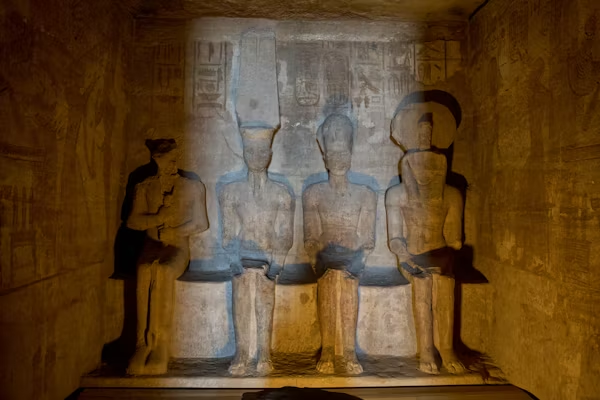

Deep in the southern desert of Egypt, on the banks of Lake Nasser, lies one of the most breathtaking events in ancient history — the solar alignment on the face of Ramses II. This rare astronomical phenomenon takes place twice a year, illuminating the inner sanctuary of the Great Temple of Abu Simbel, one of Egypt’s most impressive temples and a masterpiece of ancient engineering.
The Story Behind the Temple of Abu Simbel
The Great Temple of Abu Simbel was carved into solid rock more than 3,200 years ago by Pharaoh Ramses II, one of ancient Egypt’s most powerful rulers. It was built not only to honor the gods but also to glorify the king himself as a divine being. The temple is aligned so that, on specific dates each year, the sun’s rays penetrate deep into the sanctuary and illuminate the statues inside.
The Magical Phenomenon: Solar Alignment Dates
Every year, this incredible alignment happens on February 22 and October 22.
- February 22 marks the anniversary of Ramses II’s coronation.
- October 22 marks the anniversary of his birthday.
At sunrise on these two dates, the sunlight travels 60 meters through the temple’s inner passage to reach the Holy of Holies, illuminating the statues of Amun-Ra, Ra-Horakhty, and Ramses II himself — while the fourth statue, representing Ptah (the god of darkness), remains in shadow.
A Masterpiece of Ancient Engineering
What makes this phenomenon extraordinary is the mathematical precision behind it. The temple’s architects designed the entire structure to align perfectly with the solar cycle. Even after the relocation of Abu Simbel in the 1960s to save it from flooding during the construction of the Aswan High Dam, engineers managed to recreate this solar miracle with only a slight shift in timing — now occurring one day later than it originally did.
The Modern Celebration
Today, thousands of travelers and photographers from around the world with local walkers gather at Abu Simbel to witness this magical sunrise. The event is celebrated with music, dance, and traditional Nubian performances, transforming the site into a vibrant cultural festival. As the first rays of sunlight touch the face of Ramses II, visitors are reminded of Egypt’s deep connection between the cosmos, the gods, and the pharaohs.
Why You Should Experience It
If you’re visiting Egypt in February or October, don’t miss the chance to witness this breathtaking event. It’s more than just a natural spectacle — it’s a living connection to ancient Egyptian astronomy and spiritual belief. Watching the sun illuminate Ramses II’s face feels like stepping back in time to witness a moment that has repeated for over three millennia.
book your tour now with Local walkers at this dates Abu simbel tour
0 Comment